

GAMeC continues its participation in Artists’ Film International, the prestigious video art network established in 2008 by the Whitechapel Gallery and now curated by Forma. The initiative brings together this year twelve international contemporary art institutions, along with artists from around the world.

The 2026 edition of the program, A Kind of Power, brings together a selection of films that renegotiate the fraught legacies of representation and respond to the conditions under which people, histories, and territories are made visible.
Many of the artists move beyond critique alone, to explore how moving-image might create new forms of relation, attention, and collective presence. While some works confront contemporary systems of visibility directly, others propose alternative ways of inhabiting and understanding the world through ritual, memory, reciprocity, and acts of witnessing.

For this edition, GAMeC curators Sara Fumagalli and Valentina Gervasoni have selected the film Sight Unseen (2019) by Italian artist Alessandra Ferrini (Florence, 1984).

It is based on the most complete–but legally unpublishable until 2021–series of images documenting Libyan anticolonial leader Omar al-Mukhtar’s capture, trial and state killing by Fascist Italy in 1931.
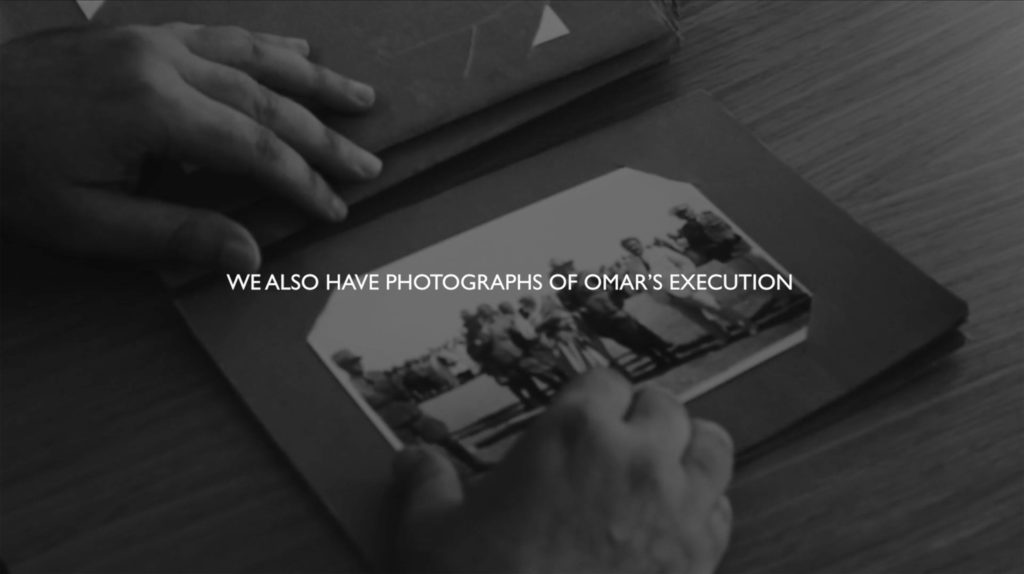
The voice and hands of historian Alessandro Volterra show and describe these images to the camera, although these are never fully revealed: barely discernible, they are faded to black, blurred, shown for just an instant.
Conveying the concealment and marginalisation of these images (and their legal ban), the film interweaves other documents and artefacts attesting to the carefully orchestrated politics of visibility and invisibility that shape the memory of colonial violence in Italy.

The film invites us to reflect on who has the right to see, who can be represented, and under what conditions. By turning the visual ban into a critical opportunity, Ferrini reflects on the role of photography within a colonial memory that has never been fully addressed, questioning how to reactivate these images of dominance without reproducing their violence.

It is precisely in this dimension of making the gaze accountable that the work finds its ideal place within Pedagogy of Hope: one of its central premises is that education should provide the tools to read the world critically and to recognize the power structures that shape its representations. Sight Unseen perfectly embodies this perspective, creating the conditions through which viewers can critically examine the mechanisms by which history is told, obscured, and forgotten.

Alessandra Ferrini herself will further develop these reflections on September 18 and 19 during two events designed to delve deeper into the path traced by the film: through a workshop at GAMeC and a performance-lecture at Performatorio, the artist will invite participants to investigate how Italy’s colonial legacy continues to condition our visual representations, our gaze, and the complex geopolitical dynamics of the Mediterranean.
Further information at this link.


From September 9 to November 1, 2026, Sight Unseen will be on view to the public in GAMeC’s exhibition spaces; at the same time, the films proposed by the other institutions participating in the 2026 edition of Artists’ Film International will be available online on this page:
 
On the edge of Canvas, by Razia Akbari
Selected by Center for Contemporary Arts Afghanistan in eXiLe e.V. (CCAA in EXiLe), Frankfurt

When one tries to create a barrier between the past, present, and future, the distances are unconsciously removed, as if no distance had been crossed between them. This film is a movement between layers, an exploration in layers of lost patterns, mute names, invisible bodies, faces in the haze, and poems neither spoken nor heard. An attempt to search for what remains unwritten among the forgotten layers of history, a search deep into the seams, where colors, lines and forms silently scream, where the gaze becomes a visual intuition.

Raindrops For Rani, by Aqsa Arif
Selected by Tramway, Glasgow

Raindrops of Rani draws on the tragic figure of Heer from the Punjabi love story Heer Ranjha. Arif reimagines her as Heera, a displaced mother navigating life in a Scottish high-rise flat with her young daughter after a flood destroys their home. Through this hybrid fantasy, Arif stages a layered narrative of a mother and daughter adapting differently and unequally to an environment marked by indifference and hostility. At its core lies the story of Arif’s own arrival in the UK from Pakistan. Her family was initially placed in a high-rise council flat in Prospecthill Circus, on Glasgow’s Southside. Years later, they were moved again by local authorities to facilitate the production of Sony Bravia’s 2006 Paint advert, an extravagant campaign requiring 1,500 explosive charges and 70,000 litres of paint. Directed by Jonathan Glazer with a reported budget of £2 million, the advert became an iconic spectacle. Meanwhile, the mostly working-class residents, refugees and asylum seekers, were displaced and rehoused in other Glasgow high-rises. Raindrops of Rani, reflects on the stark contrast between this global spectacle and the overlooked realities of the community it disrupted.

Regarding Faustine, by Ira Goryainova
Selected by argos centre for audiovisual arts, Bruxelles

Starting with the premise that any documentary portrayal has something dominating and destructive in its nature, this short essay tackles the relationship between the director and her protagonist, Faustine. The act of looking becomes tangible through technology, superstitions and fantasmatic seeing. A film, it states, is a space that takes a real-life person hostage, engulfs, and seals them in forever.

nepantlera, by Kiyo Gutiérrez
Selected by Los Angeles Contemporary Exhibitions (LACE), Los Angeles

nepantlera is an experimental video that documents a series of ritual-performances activated in specific locations along the bodies of water that delineate the border between México and the United States, that is the Gulf of México, the Rio Bravo/Grande River, the Colorado River, the Gila River, The Tijuana River and the Pacific Ocean. La nepantlera, a being/force/goddess/extinct creature embarks on a mythical journey to communicate with the waters that she gave birth to in ancient times. But she soon finds out that the rivers have been raped, and their waters have been partitioned by ambitious unsatiable men. Throughout la nepantlera’s pilgrimage, which begins at the mouth of the Rio Bravo/Grande River in Brownsville, Texas, and concludes at the Pacific Ocean in Tijuana, México, the Treaty of Guadalupe Hidalgo, the historical document that turned these waters into borders, is transgressed, transformed, and consumed through gestures such as marking, sound-making, ripping, chewing, salivating, and soaking. These gestures, involving natural dye, voice, rattle sounds, saliva, ocean and river water, touch, alter, and erode the treaty’s imperialist pages, challenging its authority and reimagining its significance. This project was crafted out of a deep concern for the land and human violence that occurs daily in the border, while also considering this space as a complex multilayered watery place where resistance, reciprocity, memory, stories and new possibilities arise.

Content Moderator, by Marte Hodne Haugen
Selected by Tromsø Kunstforening, Tromsø

Content Moderator takes inspiration from Marte Hodne Haugen’s previous work as a content moderator, working for one of the world’s biggest social media platforms. Based on the company’s rules, the moderators decide whether controversial content containing, amongst others, violence, pornography, online bullying, racism or threats of suicide should be deleted or stay up. The job is paid poorly and often done by young people, or those who don’t have many other opportunities in the job market.
The music video touches on the mental health impacts of consuming such a massive quantity of real violent imagery, in addition to our rights to safety online and to safety in the workplace. Everyone who participated in the video is a former colleague from Haugen’s time working as a moderator.

Thokei, by Malik Irtiza
Selected by Project 88, Mumbai

Malik Irtiza’s Thokei follows a figure from her childhood stories and recurring one in her artistic work; Shokpaseen is a shadowy non-being, void-like figure. It was once a songbird,but now roams strange places, as a trace of life which refuses to enter the void. Shokpaseen is specifically drawn to slippages between time and space. Thokei (spit) flows across waterscapes and (non-) language, absence and profusion, madness and humour. The sounds in this short film crash onto one another: fishy turmoil, Kashmiri lullabies,clapping hands. It creates strands of non-deterministic but unequivocal solidarity across occupied territories and the pain of bearing witness to those who live and imagine within them, even as it dwells within the oneiric and fantastical. Malik’s work resists easy legibility, finding kinship and alliance in more-than-human, plural, and obfuscated vocabularies.

The Kite Ballet, by Thaís Muniz
Selected by Crawford Art Gallery, Cork

The Kite Ballet (2024) by Thaís Muniz portrays the weekly ritual of kite runners among the Abaeté dunes, sunsets, and prevailing light winds in the Itapuã area of Salvador, Brazil. The community skilfully operates its dancing kites, creating an important physical and symbolic place for Afro-Indigenous memories and ancestral territory, where lived spiritual practices have existed for centuries.
Highlighting the threat of development to Afro-Indigenous territory in Brazil, Muniz’s film advocates for play in adulthood and negotiations with nature as essential, revolutionary acts of resistance. Through the film, she seeks to emphasise the community’s activation of the territory while amplifying the voices of local activists.
Thaís Muniz’s practice spans multiple mediums to critically engage with the geopolitics of place while investigating the intersections between inherited and acquired identities, memory, transit, and interior love as a methodology for radical care. In The Kite Ballet, these themes intertwine with ideas of degrowth, which, as decolonial and Indigenous perspectives, challenge growth-driven exploitation and propose alternative ways of living in harmony with nature.

Zoologische Gesellschaft, by Ann Oren
Selected by Video-Forum di Neuer Berliner Kunstverein (n.b.k), Berlin

Weaving audio-visual recordings of zoo-animals into a fine web comprising of actions and reactions, this video finally spirals into a collective animalistic concert. Relating the different animals to each other through audio-visual montage creates fictional relations amongst the animals; a society of animals. Zoologische Gesellschaft (Zoological society) thus comments on human communities, who created zoos as mirror images. There is an otherness there, and at the same time a disturbing proximity, which we’d like to dismiss.

Open Country, by Amaal Said
Selected by Forma, Londra and Focal Point, Southend

Amaal Said’s Open Country (2025) explores visibility, belonging, and the politics of movement within the contemporary British landscape. Following a Somali mother and daughter travelling from London into the Kent countryside, the film reflects on how histories of migration, race, and national identity continue to shape who is permitted to occupy and move through particular spaces, and under what conditions they are seen. The landscape emerges not as neutral terrain, but as a site shaped by inherited cultural imaginaries, where inclusion and exclusion remain deeply embedded.
As the daughter records an audio cassette diary for her grandmother in Somalia, the film unfolds through gestures of conversation, observation, and reflection. The cassette becomes both testimony and connective thread: a means of speaking across distance, generations, and geographies. Through this layered act of address, Open Country foregrounds the emotional and political dimensions of diasporic life, navigating tensions between familiarity and estrangement, presence and longing.
Adopting a restrained and attentive visual language grounded in care and lived experience, Said resists spectacle or fixed narratives of identity. Instead, the film lingers within moments of stillness and attention, proposing visibility as something fragile, relational, and self-determined — shaped as much by the right to appear as by the freedom to move, belong, and remain partially unseen.

Non-Aligned Newsreels: Voices from the Debris [Algiers sessions], by Mila Turajlić
Selected by Cultural Centre of Belgrade, Belgrade

Video News
Selected by Sapieha Palace, branch of Contemporary Art Centre (CAC), Vilnius

Video News is an ongoing project initiated by artist Ieva Kotryna Ski together with Akvilė Kabašinskaitė. The project connects people in different locations through an evolving video conversation — without comments or words. From time to time, the videos were combined with almost no editing, preserving the original sequence in which they were shared via WhatsApp. In total, 17 videos were created and later on published on YouTube; the 17th video, however, remained unpublished until now. The conversation was active between 2018 and 2020, though Video News still occasionally reactivates for special occasions.
Participants: Ieva Kotryna Ski, Akvilė Kabašinskaitė, Ignė Narbutaitė, Deniz Inceoglu, Lukas Brašiškis, Viltė Bražiūnaitė, Mark Prendergast, Cihangir Cakar, Ignė Smilingytė, Noriko Satoi, Milda Januševičiūtė, Yasemin Szawlowski.